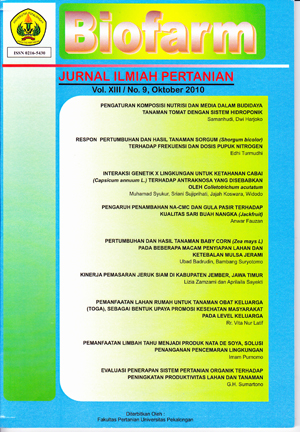
PENGATURAN KOMPOSISI NUTRISI DAN MEDIA DALAM BUDIDAYA TANAMAN TOMAT DENGAN SISTEM HIDROPONIK
DOI:
https://doi.org/10.31941/biofarm.v13i9.273Abstract
Teknologi hidroponik merupakan salah satu cara yang digunakan untuk meningkatkan produktivitas tanaman secara efektif dan efisien. Penelitian ini bertujuan untuk mendapatkan macam media dan komposisi nutrisi terhadap pertumbuhan dan hasil tanaman tomat secara hidroponik. Penelitian dilaksanakan di screen house Fakultas Pertanian Universitas Sebelas Maret Surakarta pada bulan Mei sampai dengan September 2006, dengan ketinggian tempat 95 m di atas permukaan laut. Metode yang digunakan adalah Rancangan Acak Lengkap (RAL) dengan dua faktor yang disusun secara faktorial dengan lima ulangan dan satu sampel tiap kombinasi perlakuan. Faktor pertama adalah media tanam, yaitu arang sekam (M1) dan abu sekam (M2). Faktor kedua adalah macam komposisi nutrisi, yaitu N1 (Mix A dan B standart Joro), N2 (Urea + SP36 + KCl + Gandasil D dan B), N3 (Urea + SP36 + KCl + resep Hogland), N4 (ZA + SP36 + KCl + Gandasil D dan B), dan N5 (ZA + SP36 + KCl + Gandasil D + PPC Alami). Hasil penelitian menunjukkan bahwa media arang sekam dapat mempercepat terjadinya pembungaan, dan interaksinya dengan nutrisi N1 (Mix A dan B standart Joro) memberikan hasil yang lebih baik terhadap tinggi tanaman, jumlah buah, bobot buah, dan diameter buah tomat.
Kata kunci : Tomat, hidroponik, komposisi nutrisi, arang sekam.
Downloads
Issue
Section
License
Authors who publish with this journal agree to the following terms:
Authors retain copyright and grant the journal right of first publication with the work simultaneously licensed under a Creative Commons Attribution License that allows others to share the work with an acknowledgement of the work's authorship and initial publication in this journal.
Authors are able to enter into separate, additional contractual arrangements for the non-exclusive distribution of the journal's published version of the work (e.g., post it to an institutional repository or publish it in a book), with an acknowledgement of its initial publication in this journal.
Authors are permitted and encouraged to post their work online (e.g., in institutional repositories or on their website) prior to and during the submission process, as it can lead to productive exchanges, as well as earlier and greater citation of published work (See The Effect of Open Access).