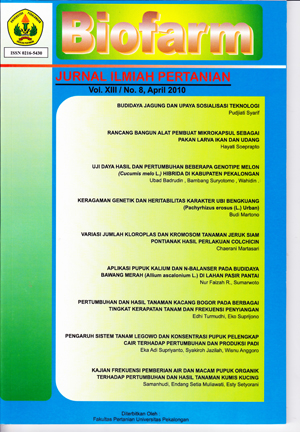
PENGARUH SISTEM TANAM LEGOWO DAN KONSENTRASI PUPUK PELENGKAP CAIR TERHADAP PERTUMBUHAN DAN PRODUKSI PADI
DOI:
https://doi.org/10.31941/biofarm.v13i8.270Abstract
Penelitian bertujuan untuk mengetahui pengaruh sistem tanam legowo dan konsentrasi pupuk pelengkap cair terhadap pertumbuhan dan produksi padi ini telah dilaksanakan di desa Pejangkaran kelurahan Karangasem kecamatan Batang Kabupatan Batang, mulai dari bulan Desember 2007 sampai bulan April 2008. Rancangan percobaan yang digunakan adalah Split Plot Design dengan rancangan dasar Rancangan Acak Kelompok Lengkap. Sistem tanam legowo ditempatkan sebagai petak utama terdiri atas 4 taraf, yaitu : L1 (25x25 cm), L2 (25x12,5x40 cm), L3 (25x12,5x50 cm), dan L4 (25x12,5x60 cm), sedangkan konsentrasi pupuk pelengkap cair ditempatkan sebagai anak petak, terdiri atas 4 taraf, yaitu P0 (tanpa pupuk pelengkap cair), P1 (2 ml per liter air), P2 (4 ml per liter air), P3 (6 ml per liter air). Kombinasi perlakuan ada 16 dengan 3 kali ulangan.Variabel yang diamati meliputi tinggi tanaman, jumlah anakan total per rumpun, umur berbunga, jumlah malai per rumpun, jumlah gabah isi per rumpun, bobot gabah kering per petak, bobot 1000 butir gabah, panjang malai, jumlah gabah hampa per malai, bobot gabah kering per rumpun.
Hasil penelitian menunjukkan bahwa sistem tanam legowo berpengaruh nyata terhadap jumlah malai per rumpun, bobot gabah kering per petak dan berpengaruh sangat nyata terhadap panjang malai. Konsentrasi pupuk pelengkap cair berpengaruh sangat nyata terhadap tinggi tanaman, jumlah malai per rumpun, jumlah gabah isi per malai, bobot gabah kering per petak, bobot 1000 butir gabah, panjang malai, jumlah gabah hampa per rumpun, bobot gabah kering per rumpun. Interaksi antara sistem tanam legowo dengan konsentrasi pupuk pelengkap cair terjadi pada variabel jumlah malai per rumpun
Kata Kunci : Padi, Sistem Tanam Legowo dan Pupuk Pelengkap Cair
Downloads
Issue
Section
License
Authors who publish with this journal agree to the following terms:
Authors retain copyright and grant the journal right of first publication with the work simultaneously licensed under a Creative Commons Attribution License that allows others to share the work with an acknowledgement of the work's authorship and initial publication in this journal.
Authors are able to enter into separate, additional contractual arrangements for the non-exclusive distribution of the journal's published version of the work (e.g., post it to an institutional repository or publish it in a book), with an acknowledgement of its initial publication in this journal.
Authors are permitted and encouraged to post their work online (e.g., in institutional repositories or on their website) prior to and during the submission process, as it can lead to productive exchanges, as well as earlier and greater citation of published work (See The Effect of Open Access).